
Pulaski Parole and Probation
Parole and probation both allow a person to live outside a jail or prison while following set terms, but the legal paths differ. A court normally imposes probation. It may follow a jail or prison term, or the judge may suspend some active time and order probation instead. Parole is conditional release before the end of a parole-eligible prison term. The Virginia Parole Board makes the discretionary release decision, while Virginia Department of Corrections Community Corrections administers adult state supervision after release.
Virginia did not erase parole in every case. Virginia Code § 53.1-165.1 abolished discretionary parole for most felony offenses committed on or after January 1, 1995, but older eligible sentences and statutory exceptions remain under rules that include Virginia Code § 53.1-151. Geriatric or other conditional release also follows its own law. The sentence date, offense, and court order therefore matter more than a broad claim that Virginia has no parole.
| Point | Probation | Parole |
|---|---|---|
| Source | Court sentence or order | Parole Board and governing statute |
| When it begins | As ordered, sometimes without prison | After release from a parole-eligible prison term |
| Administrator | VADOC or an eligible local program | VADOC Community Corrections |
| Best proof | Court order plus active supervision confirmation | Board action, release papers, and VADOC confirmation |
Verify Pulaski County Supervision
Start with the custody class. Adult state probation and parole are checked through the VADOC Inmate and Supervisee Locator. The locator is more useful for active custody and active supervision than for every old discharge. VADOC says its information is updated daily, yet it may be inaccurate or dated. Preserve the exact displayed wording and do not turn a supervisee status into a claim that all court duties are complete.
- Gather the full legal name, date of birth, and VADOC number if known. Use more than a name for a common match.
- Search the VADOC locator and compare each plausible record. Note whether the result describes incarceration or community supervision.
- Check the sentencing, probation, or revocation order in the correct Pulaski court. The order establishes the term the judge imposed.
- Compare any office field with District 28. Contact that office when the public result is unclear or a current assignment must be confirmed.
- For discretionary parole, review the Board's published action. Then confirm actual release through VADOC records or signed release papers.
The county-jail route is different. New River Valley Regional Jail records a local custody release, while Virginia Jail VINE can report an event from that jail. Neither source establishes a state probation term by itself. The full Pulaski County release and records path is described on the released inmate search home page.
Pulaski County District 28 Supervision
Pulaski County is served by VADOC Probation and Parole District 28 in Radford. It is not housed in an office named Pulaski. VADOC lists the district's service area as the City of Radford and Floyd, Montgomery, and Pulaski counties. That regional coverage explains why a valid Pulaski supervision record may point to Radford rather than a county office.
VADOC Probation and Parole District 28
2003 West Main Street
Radford, VA 24141
540-831-5850
State adult probation and parole for Radford, Floyd, Montgomery, and Pulaski.
The VADOC facilities and offices listing is the source for the district card and service area. The captured listing below helps identify the right office before a call.
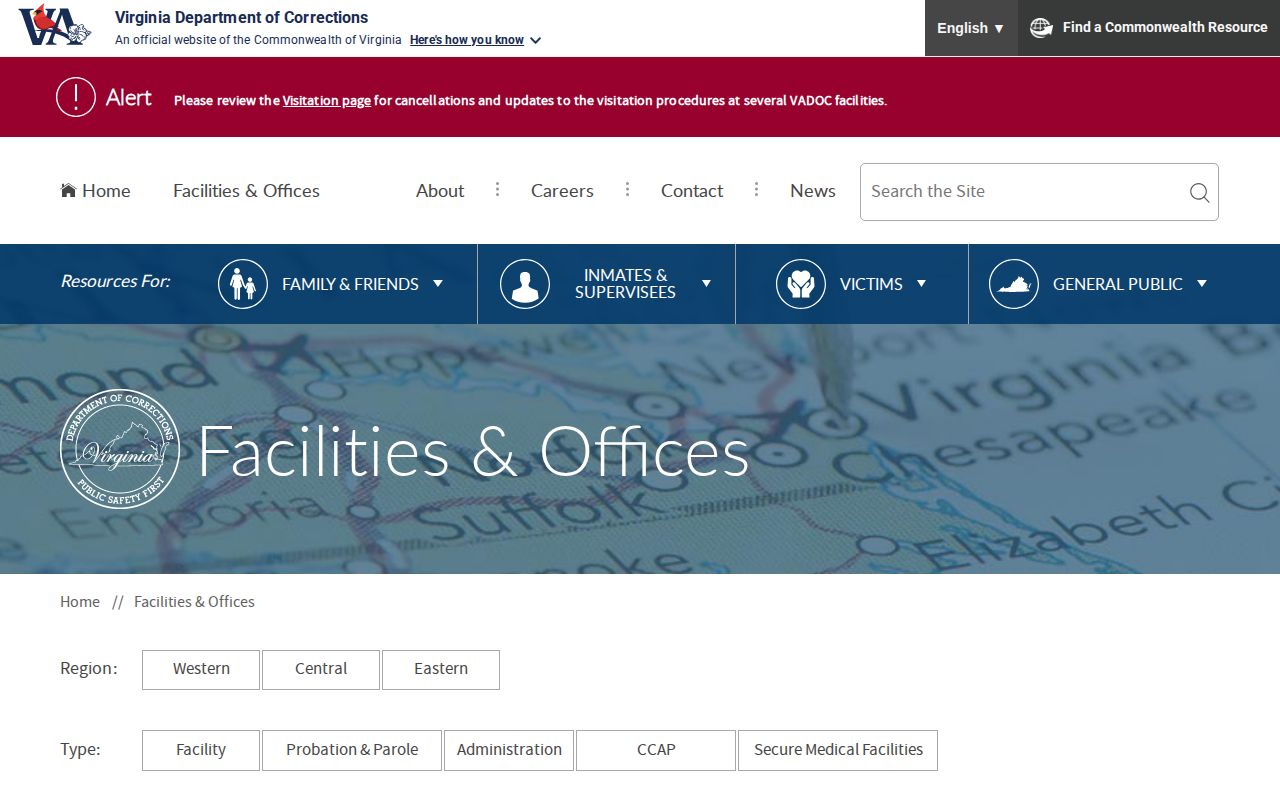
Use the current live listing for later changes. A district confirmation may be limited to information that staff can lawfully release, so the court order remains the best source for the term imposed.
Pulaski Local Probation Is Separate
New River Valley Community Corrections and Pretrial Services is a second supervision channel. Its Pulaski office serves the 27th Judicial District. The program handles pretrial supervision and local offender probation in eligible cases. Pretrial supervision means a person is outside custody while a charge remains pending. Local probation follows a qualifying court order. Neither status should be called state parole.
The county community corrections page lists the office at 58 North Washington Avenue, P.O. Box 191, Pulaski, VA 24301, with telephone 540-994-5061. Posted hours are Monday through Thursday, 8:30 a.m. to 4:00 p.m., and Friday, 8:30 a.m. to 2:30 p.m. Use that office for its own cases. Send adult state probation and parole questions to District 28.
Note: A bond release with pretrial monitoring is not parole, even when both require reports, travel limits, or other court-approved terms.
Pulaski Parole Decision Records
The Virginia Parole Board decides discretionary parole and specified conditional-release matters. District 28 does not make that release decision. The Board's public meeting page is the closest official calendar, but it is not a calendar of every review. Under § 53.1-136, when the Board is inclined to grant discretionary parole or geriatric conditional release, it meets the person by video and posts an agenda at least three working days before that meeting. Not every eligible person receives a public meeting.
The Board's Monthly Decisions reports publish actions by month and year. Use the report's exact result terms, including “Not Grant” where shown. A favorable action is still not the physical release time. VADOC must set and process the release, and the signed release documents confirm the custody change.
The separate Public Meetings page follows an event-driven schedule rather than a fixed weekly or monthly calendar. The archive viewed during research listed meetings on January 7, January 14, June 25, July 9, July 23, and July 30 in 2026. Those uneven dates show why the live calendar must be checked. They do not establish that a particular person received a hearing, and the meeting notice does not replace the later decision report.
The manifest capture below comes from the official decision index used to locate those monthly records.
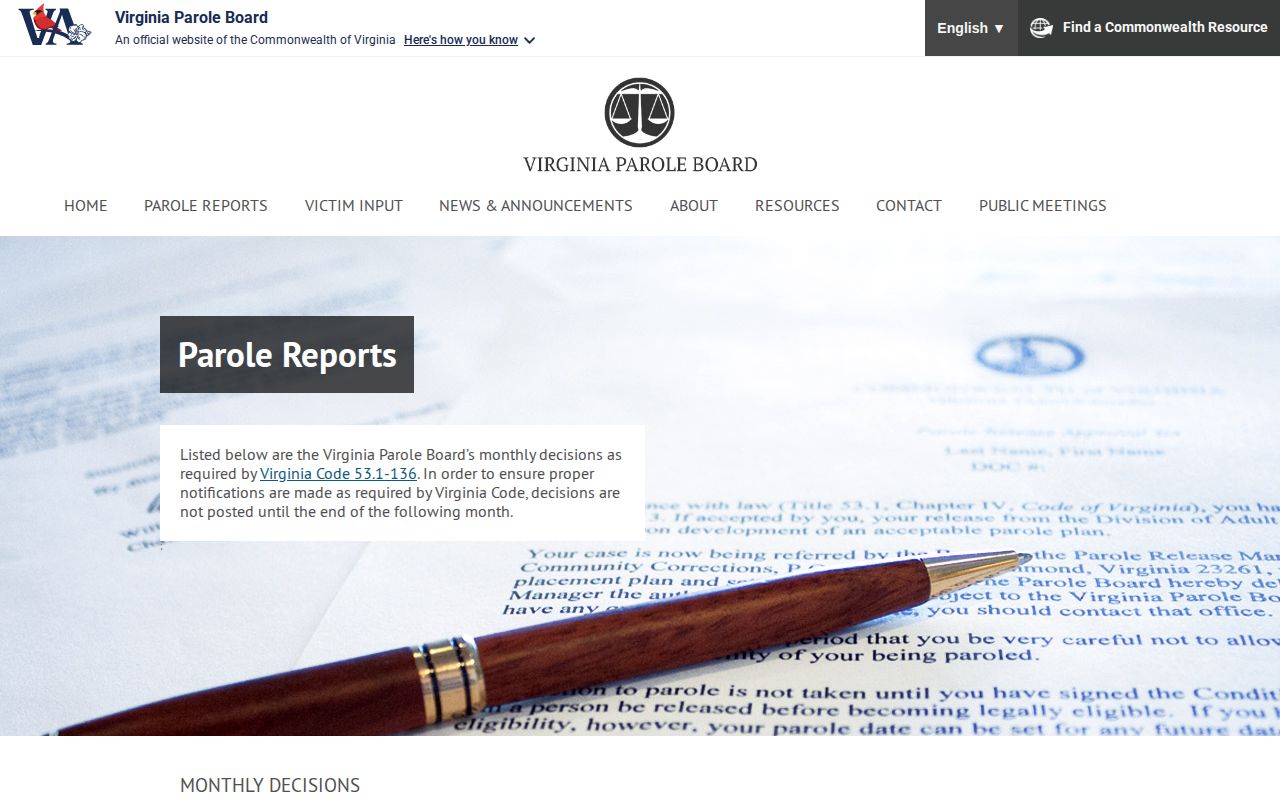
The index answers what action the Board published. VADOC status, NAAVI notification, and release papers answer whether and when state custody actually ended.
Note: A published Board result documents the decision, while VADOC's release record documents the later change in physical custody.
Pulaski Supervision Terms and Violations
Conditions are rules attached to release or sentence. The signed Conditions of Probation or Conditions of Parole document gives the terms for one person. Common high-level duties can involve reporting, obeying court orders, staying within approved travel limits, and completing programs, but only the actual order and signed conditions control. Public locator data do not disclose every term.
A violation is an alleged failure to comply. An absconder is a supervisee alleged to have stopped reporting or whose location is unknown to the supervising authority. Neither word alone proves a new conviction. Virginia Code § 53.1-161 permits a Parole Board member to issue a warrant for arrest and return of a parolee on probable violation. Use official VADOC Most Wanted information or law enforcement to check a live warrant. Never infer one merely because a locator record changes or disappears.
- Supervisee
- A person managed in the community by a corrections or court program.
- Absconder
- A supervisee alleged to have stopped complying with reporting or location duties.
- Revocation
- A court or Board action that can cancel conditional liberty after due process.
- Discharge
- The formal end of a custody or supervision term.
Pulaski Release Notification Boundaries
Notifications follow custody, not every form of supervision. Virginia Jail VINE serves local and regional jail events, including the New River Valley Regional Jail route. It can report release or transfer, but updates stop after release and it is not a permanent supervision record. VADOC now uses NAAVI for its state-prison notification program. VADOC says NAAVI does not cover probationers, parolees, or local-jail inmates.
A transfer from NRVRJ to VADOC can require a new state registration. An actual VADOC release alert means VADOC custody ended; it does not mean probation or parole ended. Search the locator and contact District 28 for the separate supervision question.
Note: A transfer alert marks a change in custodian, while a release alert marks the reporting agency's custody ending.
Pulaski Post-Release Edovo Access
NRVRJ links a rare digital-continuity resource for people who used Edovo while in custody. The jail's Edovo post-release access link directs users to the process for requesting an Edovo Go account. Continued access may help a former user reach prior learning material after leaving the jail.
This resource does not confirm custody status, parole, probation, or discharge. Use it only for account access. A release date must come from the jail record, and supervision must be checked through the correct state or local office.
Pulaski Supervision Discharge Records
Supervision ends through a formal discharge, court action, expiration under the controlling terms, or another authorized decision. A locator absence does not serve as a discharge certificate. For state supervision, ask VADOC for the existing releasable record when the public entry does not resolve the question. For court probation, request the final order from the correct Pulaski court. For local community corrections, contact that program about the record it maintains.
Match the name and date of birth across sources. Then compare the court term, VADOC administration, and any Board action. This three-part check prevents a past jail release from being mistaken for the end of supervision and prevents an active supervisee record from being mistaken for current incarceration.