
Pulaski Projected Versus Actual Release
A projected release date is an agency estimate based on the sentence information and credits then in the record. An actual release date records a completed custody event. That distinction is vital in Pulaski County because the two main systems use similar words for different purposes. New River Valley Regional Jail's lookup has a Release Date column for bookings found after selecting “Include released inmates.” VADOC uses “projected release date” for a future state-sentence calculation.
A person awaiting trial usually has no computed sentence end. A judge may grant bond or recognizance, but the jail still must verify identity, confirm release authority, and check other holds. A court decision can therefore come before physical departure. A sentenced person may have a calculated date, yet a new order, detainer, credit change, or disciplinary action can move it.
Note: NRVRJ's recorded Release Date should not be copied into a future projection, and a VADOC estimate should not be described as completed release.
Find Pulaski Projected Release Dates
Begin by deciding whether the person is a local detainee, a VADOC prisoner, or a federal inmate. Pulaski County adults are housed locally at NRVRJ, not at a stand-alone Pulaski jail. A transfer to VADOC ends the local booking but continues state custody. Federal and immigration systems are separate and cannot verify a county or state calculation.
- Search the NRVRJ inmate lookup for a local booking. Check “Include released inmates” when confirming a past release.
- Read the Pulaski court docket and signed order. A bond event, active sentence, suspended time, or amended order changes the question being asked.
- For state custody, search the VADOC Inmate and Supervisee Locator with the exact name and VADOC number when available.
- Save the date and exact status shown, along with the retrieval date. VADOC warns that locator data are updated daily but can be inaccurate or dated.
- Ask the holding agency or VADOC Time Computation unit to confirm the current figure when precision matters.
The broader Pulaski County released inmate search explains how to reconcile a local release record with court, state, federal, and ICE sources. Do not treat a missing live jail result as release proof. It can also reflect a transfer, spelling problem, lag, or protected record.
Pulaski Release Date Custodians
The physical facility and the legal custodian can differ. NRVRJ may still house someone awaiting transfer after a state sentence, while VADOC holds legal authority over the prison term and its projected date. The Pulaski court supplies the sentencing order, but it does not operate the jail or apply every later credit. When the person is federally sentenced, BOP controls the federal calculation. A federal pretrial episode may instead require the federal court or U.S. Marshals Service because BOP's public locator may not represent that custody.
Immigration custody creates another boundary. An ICE detainer can cause NRVRJ to end its booking through transfer rather than release to the community. The NRVRJ Release Date then proves only that the regional jail's episode ended. Search ICE's locator or contact the receiving office for the next custody status. No official source in the Pulaski research established an NRVRJ ICE contract, so an ICE Number field on the jail form must not be treated as proof that a transfer occurred.
| Custody event | Date authority | What it proves |
|---|---|---|
| NRVRJ booking | NRVRJ record | Local release or transfer date |
| Virginia prison term | VADOC computation | Current state projected date |
| Federal sentence | BOP record | Federal projected or past release |
| ICE transfer | Sending record plus ICE | Change from criminal to civil custody |
Note: Use both sending and receiving records when a transfer date might otherwise be mistaken for release into the community.
Pulaski VADOC Release Date Search
The VADOC locator is the correct public starting point for a person committed to Virginia state custody. Search the exact name and use the VADOC number when known. Inspect all plausible matches and compare the identifiers that the live result displays. A state prisoner may later appear as a supervisee because VADOC also administers probation and parole. That status can support release into the community, but absence from the locator is not a discharge certificate.
The official VADOC locator form shown below is a successful manifest image matched to the projected-date search route.
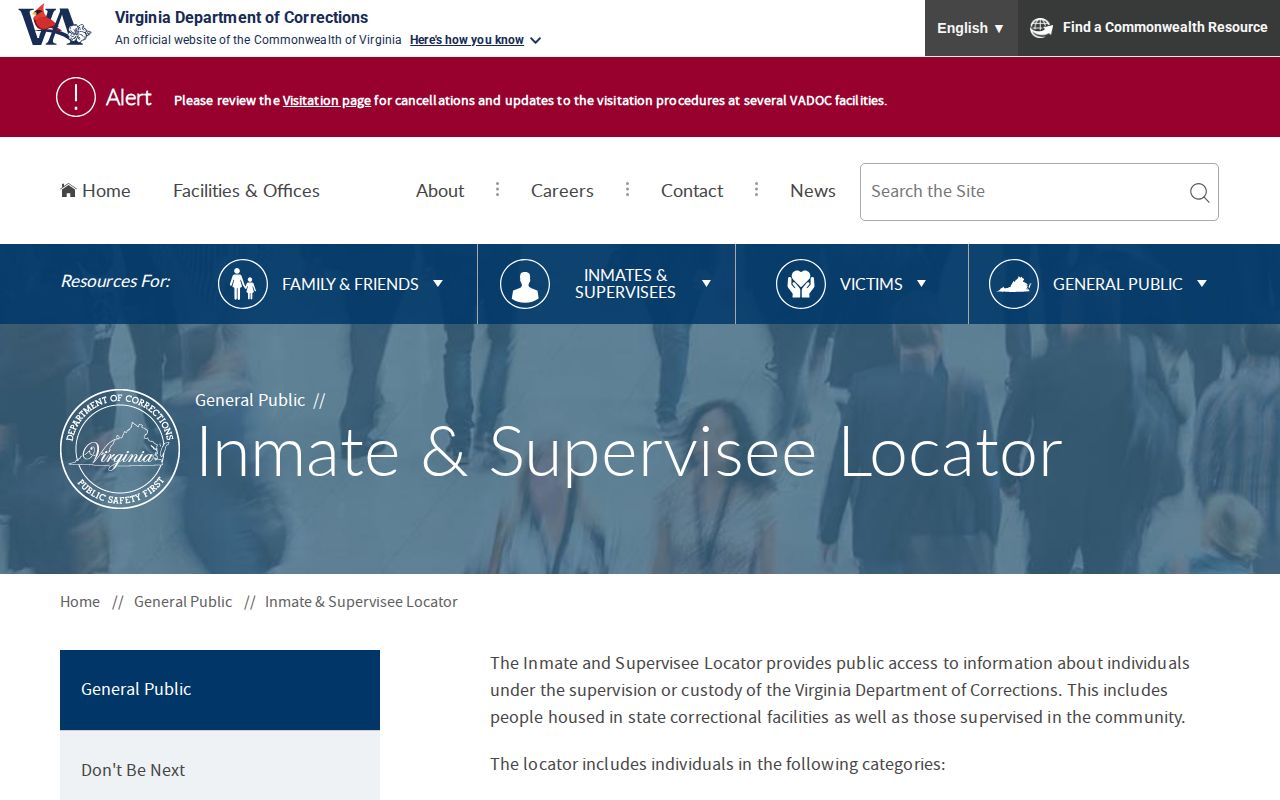
The form is only the starting screen. The individual result and VADOC confirmation supply the date and current wording. VADOC Operating Procedure 010.3 supports staff confirmation of a projected release date at the time of inquiry, so direct confirmation is appropriate when the public view is incomplete.
For an old discharge or a result that cannot be resolved, use VADOC's records-request channel. Ask for existing release-date, order, or discharge documentation. A fully inactive record may use VADOC Form 17. Request a narrow set of records rather than asking staff to calculate a new answer from scratch.
Pulaski Earned Release Date Credits
Virginia has more than one credit framework. VADOC's Time Computation page separates older Good Conduct Allowance sentences from Earned Sentence Credit sentences. Covered felonies before January 1, 1995 and covered misdemeanors before July 1, 2008 may fall under GCA rules. Later felony offenses generally use the ESC framework, subject to offense and effective-date rules.
Virginia Code § 53.1-202.2 defines an earned sentence credit as a deduction from confinement, with one credit equal to one day. Section 53.1-202.3 limits enumerated offenses to 4.5 credits for each 30 days served. For other qualifying offenses, its levels provide 15 days at Level I, 7.5 at Level II, 3.5 at Level III, and none at Level IV. Conduct, program participation, classification, eligibility, and timing all affect the level.
The familiar “85 percent” phrase is not a universal Virginia formula. The older 4.5-per-30 structure yields about 86.96 percent by strict arithmetic, and current law permits higher rates for some eligible offenses. Concurrent or consecutive terms, mandatory minimums, and pre-sentence jail credit also matter. Only the agency's individual calculation should be used for one person.
- Jail credit
- Time credited toward a sentence before VADOC receives the person.
- Earned sentence credit
- A statutory deduction based on the applicable offense and earning level.
- Mandatory minimum
- A term that the governing law does not permit credits to reduce in the usual way.
- Projected date
- The agency's current estimate, subject to later lawful changes.
Pulaski Jail Release Date Credits
Local jail computation uses a different record chain. Virginia Code § 53.1-116 requires the jailer to keep records about each committed person, the cause and terms of commitment, receipt date, prisoner record, and a written earned-credit policy. Its misdemeanor provision for qualifying sentences of 12 months or less can award one day of credit for each day served when jail rules are followed, subject to mandatory-minimum and other limits. Felony credits remain governed by the applicable state framework.
NRVRJ's public lookup does not expose a future Pulaski County calculation tool. For a county sentence, compare the signed sentencing order, time credited before sentence, and the jail's own record. Ask NRVRJ for the existing release or computation record when the public view only shows a completed Release Date. The court clerk can provide the order, but the court docket alone may omit jail credit, earning class, and disciplinary information.
Note: A sentence stated in months does not by itself reveal the release date because receipt dates, credits, holds, and later orders may control.
Pulaski Release Dates Can Change
A projected date can move for reasons found in several records. Record the retrieval date and the exact agency wording. When a factor changes, return to the agency calculation rather than editing the old figure by hand.
| Factor | How it affects release | Best confirmation |
|---|---|---|
| Jail time credit | Credits time served before VADOC receipt | Jail record and VADOC computation |
| Earning level or discipline | Adds, reduces, or stops lawful credit | VADOC Time Computation record |
| Amended court order | Changes active or suspended sentence terms | Signed order from the clerk |
| Concurrent or consecutive term | Changes how multiple sentences combine | Sentencing documents and VADOC |
| Parole or conditional release | May set a different lawful release path | Board action and VADOC release papers |
| Detainer or hold | Can send the person to another custodian | Sending and receiving agency records |
An ICE or out-of-county hold can make the first facility's custody end without community release. Likewise, a favorable parole action is not the door-opening time. VADOC still processes the event and produces the applicable release documentation.
Pulaski State Release Day Records
VADOC's facility release page gives a concrete end point for state custody. It says discharge or parole releases occur by 11:59 p.m. on the release date, weather permitting. The person receives a notification-of-release letter and, depending on status, reads and signs an Order of Release, Conditions of Probation, or Conditions of Parole with staff witnessing the document.
Virginia Code § 53.1-28 separately permits the VADOC Director, for scheduling and prerelease purposes, to discharge a state prisoner within the final 30 days before the term would otherwise expire. It also addresses required documents. These are VADOC rules. They do not establish a release hour, weekend rule, or final-30-day practice for NRVRJ.
Confirm Pulaski Actual Release Dates
A completed local release is best shown by NRVRJ's populated Release Date plus its underlying release record. A completed state release is better shown by VADOC's status, notification-of-release letter, and signed release or conditions document. For a federal sentence, use the BOP locator and federal records. For ICE custody, use the ICE locator. Each system proves only its own custody.
Notification can help while an event is pending. Virginia Jail VINE serves NRVRJ and other local or regional jail custody. VADOC NAAVI serves the state-prison notification route and may provide an anticipated date before actual release. Those channels are separate. Details on registering for the correct custody source appear on the VINELink Inmate Search page.
Keep the projected result, the retrieval date, and the final release record. That set shows both what the agency expected and what ultimately occurred.